Printed Images: Selected Excerpts
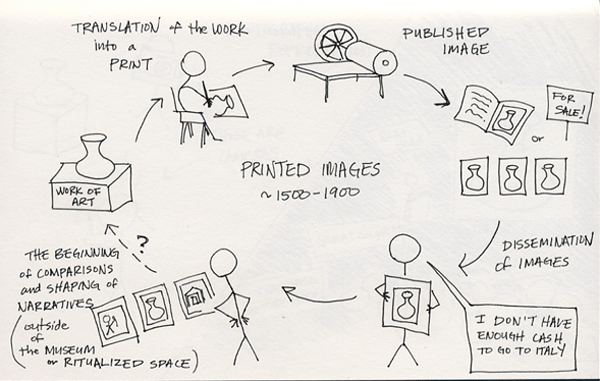
The term reproduction may be interpreted broadly to include all forms of replication and copying like as the practices mentioned above. However, to begin my partial history I am taking a narrower view of reproduction. I am concerned with images of art produced with the intent of documenting works of art and supplying the market with images of art that are available and relatively affordable to broader audiences than the original can be and how audiences users experience and employ these images. Also, before you object to my leaving out the pedagogical and market value of recasting sculpture as demonstrated by the Romans, I am also limiting this history to that of reproduced images on paper or images displayed electronically. Subsequently, the partial history of experiencing of art through reproduction begins with printmaking.
The history of creating reproducible images of existing works of art is deeply connected to the development of the book printing industry in the mid-fifteenth century. The printing of books and the subsequent rise of the book trade across the European continent were both an impetus for and response to a growing merchant class who wished to purchase texts and images, but could not afford illuminated manuscripts. Printers were able to seamlessly integrate woodblock prints with their new type because the block itself was made to be type-high, meaning the press could apply pressure evenly across the inked image and type. The printed book took many cues from its handwritten and hand illuminated counterpart. Printers arranged text in much the same manner as manuscripts, and images were integrated with text similarly. The European market, accustomed to illuminated manuscripts, unbound woodblock prints, and even bound blockbooks of images, would likely have expected there to be images in printed books. The Nuremberg Chronicle of 1493 is the most ambitious of the surviving early illustrated texts, boasting well over a thousand printed images.
The growing amount of images representing works of art in unavailable, distant places facilitated the study, comparison of art works, and the images, of course, also provided aesthetic enjoyment. We understand, or at least believe we understand, all images from within our cultural milieu on some immediate level. Within Western culture, viewing images does not require literacy in a foreign language, or even one’s own for that matter. Dana Arnold argues that this “international currency” of images explains the popularity of images during the Enlightenment:
By the opening years of the eighteenth century the proliferation of printed images ran ahead of the increased production of the printed word. The printed image became an essential component of the international currency of intellectual ideas that transcended spoken boundaries. These images facilitated the transference of ideas about architecture, antiquity, and aesthetics in the pan-European arena of artistic and scholarly exchange. (Arnold, 2002, p. 450)We might well expect scholars of the time to be fluent in multiple languages, or at least versed in the academic languages of Latin or French. Over time, however, the demand for reproduced images was much larger than the amount of scholars could feasibly generate. Images were desired by the broader public, just as affordable books were.
The increase in image production during the Renaissance and Enlightenment influenced the development and growth of the art market as well. The market for art, and art appreciation as a marker of cultural taste and distinction grew especially in the eighteenth century:
Regular public exhibitions, and the development of criticism and public discussion of art, were instrumental in forming and consolidating a public for art in both England and France. Consumption of culture increasingly went beyond purchasing works of art. It could include attendance at events, buying reproductions, or buying and reading critical and historical writings. Jürgen Habermas argued that the eighteenth century witnessed nothing less than the invention of culture per se, as a commodity to be consumed ostensibly for its own sake, through the medium of rational discussion. (Seiberling, 1998, p. 142, emphasis mine)
Raimondi is an interesting character in the history of reproduction, well worth spending a moment on. As one of many engravers and businessmen involved in the production of engraved images of works of art, Raimondi demonstrates the power that reproduced images held in the market and among artists and scholars. The Renaissance saw an increasing market for engraved images of works of art. Travelers who came to Rome wished to have images to take back with them, whether printed singly or in collections (Ivins, 1969, p. 67). Across Europe the growing middle class wished to satisfy their interest in Classical and Italian works with engravings of these works (Hults, 1996, p. 165). In 1506, Marcantonio Raimondi had already made a name for himself by copying a series of woodcuts by Dürer as engravings, complete with Dürer’s monogram; this act led the German artist to file a complaint against Raimondi in the Venetian senate (p. 162). It is important to note that Dürer was a prominent printmaker himself, making profit by selling multiple editions of his own work. Raimondi went on producing engraved reproductions of existing works of art, most famously those of Raphael. Raphael hired Raimondi to make engravings based upon his drawings, ensuring a widespread, yet vicarious, distribution of Raphael’s work across Europe. Representational accuracy suffered under the high level of production in Raimondi’s workshop, but him and his pupils provided both the general public and scholars with prints of contemporary Italian and Classical works, including the father of art history himself, Vasari. Raimondi, initially chastised by the senate for infringing upon Dürer’s print market, capitalized on the market for images of unique works of art with the cooperation of Rapael, who saw the arrangement to be beneficial.
Clearly, despite their limited potential as wholly accurate representations of works of art, engravings were vital to the development of art history. From Vasari on engraved reproductions were used as reminders of the original work, but they also spurred new considerations on the part of their viewers. With representations of original works spread before them, scholars began arranging the images according to time, place, or style; such arrangements essentially build narratives and meanings that are unavailable from the authentic works themselves. It is with engraved reproductions that we can begin to trace the importance of arranging disparate images to create narrative and meaning. In Ulrich Keller’s opinion:
The highly hypothetical operation of breaking them [artworks] out of the spatial continuum and rearranging them in temporal order required a very particular frame of mind which emerged only in the course of the eighteenth century, and I would argue that the availability of an experimental, archival arena of easily manipulable reproductions was the key precondition for this development (2001, p. 179).The necessity of reproductions for the practice of symbolically manipulating works of art is clear. Unique works of art do not lend themselves to collection and comparison by the individual.
The images did, however, articulate a conceptual understanding of the artwork that was an alternative to what Keller calls “normative, antiquarian, and itinerary discourses” (p. 180).
Picture atlases brought together multiple images of works of art on a single page. A reproduction from Séroux d’Agincourt’s History of Art by it Monuments, published in 1823, shows a page
of twenty-seven architectural facades remarkably varied in appearance. The spatial organization is even, with six to eight facades spaced across four rows of a single plate. No text or
labels interrupt the progression from one image to another. Comparisons between works could be made easily and separately from the guidance of the associated text:
Arnold builds a compelling argument for the role of engravings in constructing visual histories that run parallel to or against written and verbal histories. The multitude of images of Paestum, published at different times and by different publishers, exemplify images offering vicarious access to a unique object, as well as a means of incorporating the distant and “fragmentary” into our present (p. 456). In the case of the Paestum, engravings of the temples may be seen as elemental to eighteenth century debates about the supremacy of Greek civilization over Roman or vice versa:
The aesthetic practices evident in these various visual representations stands [sic] distinct from the constraints of verbal taxonomies. This reveals a pan-European currency of printed images of antiquity which relied on a common visual language, which in turn reveals how mass-produced studies of the antique were used as facts of fragments of knowledge which became histories. (p. 456)The common visual language of prints, however, is itself split down the middle: it portrays both fact and fragment—visual elements of rational analysis and the “unruly” imagination, respectively.
Visual rationality as a strategy of representation orders, squares, and dissects the object. It removes extraneous distractions; whole buildings float in the empty white space of the paper:
This method of representation relies on imagination as the construction of this artificial composition is the creation of something other than the object under scrutiny. The abstraction of detail…became a system of standardization akin to the dictionaries and encyclopedias which proliferated in the eighteenth century. This produced a legible language of signs which could be subjugated to verbal argument and could, if desired, follow linguistic systems. (Arnold, p. 460).Arnold contrasts the rationalized image with Piranesi’s engravings of Classical ruins which exemplify unruly images that evoke a very different sense of the same type of subject. Piranesi details the decay of a structure: stones lay fallen aside half survived walls, weeds grow through cracks, local residents pick through the ruins for stones to use elsewhere. Such representations play up a romanticized view of the Classical monuments, while reminding us that the monuments are very much part of the past (p. 464).
In the first half of this chapter, I provided an overview of the development of relevant printmaking processes used as reproductive media from the early 1400s to the early 1900s. I specifically focused upon the printed image’s compatibility with printed text. While the production and distribution of reproduced images was not dependent upon a compatibility with type, I believe that the relationship between image and text in the printer’s workshop reveals historical trends of visual experience and market demands. For example, the rise of engraving as the key reproductive medium, despite the extra labor and cost in its production, signals a demand for more sophisticated images, capable of rendering finer detail and tonal values.
For the second half of the chapter, I discussed printed images as sources of information and interpretation, as well as products to be bought and sold. Reproduced images of works of art are both representations of other objects and representations of their context. The intended, or unintended, use of reproduced images to vicariously collect, compare, and otherwise arrange works of art was primary activity in the early practices of art history. As I move into the photographic world, the use of reproduced images to form understanding and construct narratives of art will grow in strength, as will the dissemination of images across larger and larger audiences.