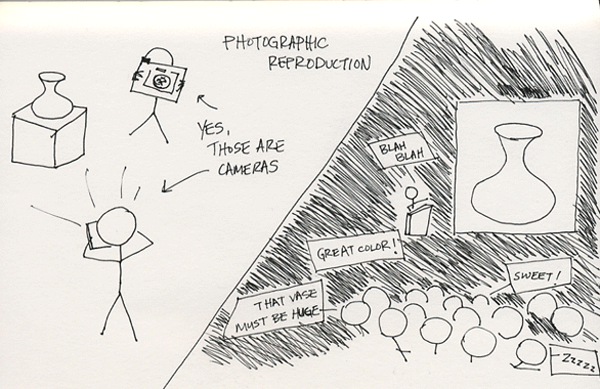
Photographic Reproduction: Selected Excerpts
Despite the problems cited above, Anthony Hamber (2003) describes printed photographic reproductions art as slowly growing in number from the 1840s to the 1870s, by which time the usefulness of photographic images, particularly in Renaissance art scholarship, was acknowledged (p. 215). Photographic prints were sold in a variety of formats including loose prints that could be collected within portfolios, cartes de visite (images of a work or collection of works, similar in dimension and simplicity to contemporary postcards and postcard books), stereoscopic cards, and as printed illustrations in art books. As the necessary developments in photographic emulsions and printing processes took hold, photographic images of art increased dramatically in the early twentieth century, challenging engraving’s dominance as the art reproductive medium.
Photographs, like prints before them, were a valuable industry in the nineteenth century. By the 1870s, photographs were available commercially through dealers throughout Europe, and presumably the United States as well. Trevor Fawcett (1986) found that in the late 1800s “various archives were in existence, and indeed most European countries had signed an international convention on art reproductions which envisaged national collections of photographs, casts and electrotypes as well as the international exchange of duplicates” (p. 206). Individual institutions appointed photographers to document their collections; as early as 1855 the British Museum hired its first official photographer Robert Fenton to photograph its collection of classical sculpture (Freitag, 1987, p. 354). Often photographers were contracted to photograph collections or assist in the creation of catalogues raisonnés of individual artists locally and abroad
As stated, our use of photography reflects a continued interest in the photograph’s ability to represent the world around in a manner that implies objectivity. We ascribe representational truth to the photographic image. Photographs provide a registration of light in a manner that is similar enough to our own experience of sight that we can easily imagine the image as true—meaning we identify with how the camera “sees” objects, and with our understanding of photographic processes, we feel some confidence that the camera registers only (and every) object in front of its lens. Cara Finnegan, paraphrasing Don Slater, describes the attribution of photographic realism to three factors:
Representational realism, the way a photograph corresponds to perspectivalism’s sense of what a ‘realistic representation’ looks like; ontological realism, where the viewer knows that what appears in the photograph must have existed in order for it to have been captures by the camera; and mechanical realism, the transformation of light reflected from an object into a visual representation of that object (Finnegan, 2001, § 3, ¶ 6).The intersection of representational, ontological, and mechanical realism produces a very powerful illusion, an illusion that is supported by our experiences with photography both as viewers and photographers. Try imagining how different your understanding of the world might be if you could not ascribe some fundamental truthfulness to the photographs you see. Much of what you know now would be called into question. Even our memories are subjected to photographic intervention, as we insist on photographing those people and places we wish to capture and keep.
Finally, I would like to consider the photographer herself as an interpretive force in photographic reproduction. Upon reflection it is obvious that a photographer cannot point her camera “objectively.” The photographer must make choices in how the work of art is to be represented, and often these choices are infused with the photographer’s aesthetics or politics. In 1913 art historian Hans Tietze expressed his concerns about the aesthetic subjectivity of the photographer:
Anyone who has ever photographed a building has consciously influenced the psychological impact of the object, be it through a foreshortening of some unsightly lines, through a loss of depth and the apparent crossing of architectural lines or through the inclusion of “mood inducing” elements such as foreground detail, etc. Clearly, our innate artistic preferences often get the upper hand when we have set out to take a documentary picture of a piece of architecture. These interpretative manipulations can, if worst comes to worst, result in the complete falsification of the artistic message of the original. (Hans Tietze as quoted by Freitag, 1987, p. 355)The photographer of works of art, or in this case, architecture, would seem to be in the problematic position of both documenting the work in a manner that is removed or emotionless, while also needing to create an image that conveys the perceived value of the work. Two competing ideals are at work: photographic “objectivity” and the romance of the original work.
Despite the inherent flaws of photography in representing important visual and physical aspects of the original work of art, in the twentieth century photographic reproduction became, in Barbara Savedoff’s words, the “paradigmatic art experience” (2000, p. 157). Savedoff attributes the reproduction as the paradigmatic art experience as a result of comfort and convenience; why battle the crowds of a blockbuster museum show when an exhibition catalog allows you to see the works of art “wherever we like and for as long as we like” (p. 157). I would add that without widely available photographic reproductions the crowds at blockbuster shows would be significantly thinner. The social complexity of the reproduced image is in its divergent paths. Is art augmented by its reproduction, or is the value of the original work and its aura lessened?
There is little argument that the development of photography in the mid-1800s changed the character of visual information, its production and dissemination. While reproduced images created by artists, craftsmen, and printers were certainly valued as informational and artistic objects, photographs removed the tangible sense of the human hand in the image’s creation. The development of the Kodak hand held camera in 1888 enabled photography to popularly practiced. The mechanized reproduction of images fit in nicely with other nineteenth and early twentieth developments in industrial production, and the rising power of the lower and middle classes.
In Techniques of the Observer: On Vision and Modernity in the Nineteenth Century, Jonathan Crary turns to Baudrillard’s description of the shifts of the nineteenth century in order to situate Crary’s nineteenth century observer. Baudrillard describes the breakdown of bourgeois social power as partly a result of available techniques of copying and “a proliferation of signs on demand” (Crary, 1990, p. 12). This theory echoes Walter Benjamin’s Marxist interpretation of mechanical reproduction, namely photography and film, as an assertion of proletariat power that was discussed in chapter one. Photography inspired a new visual and cultural landscape by acting as extensions or embodiments of a formerly precious and guarded world. Unique works of art, formerly the exclusive visual property of the bourgeois, are pulled into the larger circulation of images. Photography enables a new medium of mass communication, a unifying and “totalizing” system of value, synonymous with money:
The photograph becomes a central element not only in a new commodity economy but in the reshaping of an entire territory on which signs and images, each effectively severed from a referent, circulate, and proliferate. Photographs may have some apparent similarities with older types of images, such as perspectival painting or drawing made with the aid of a camera obscura; but the vast systemic rupture of which photography renders such similarities insignificant. Photography is an element of a new and homogeneous terrain of consumption and circulation in which an observer becomes lodged. To understand the “photography effect” in the nineteenth century, one must see it as a crucial component of a new cultural economy of value and exchange, not as part of a continuous history of visual representation…Photography and money become homologous forms of social power in the nineteenth century. They are equally totalizing systems for binding and unifying all subjects within a single global network of valuation and desire. (p. 13)The production and consumption of photographic equivalences and their impact on the viewer is significant. The observer is found in this new system where there is “a new set of abstract relations between individuals and things” and the prevailing culture determines the abstract relations to be real (p. 13).
Drawing Crary’s analysis into a more specific and experiential contrast of photographic representations and engraved representations of the nineteenth century, it is possible that an element of the photography effect is the lack of interpretive room given by photography. Engravings were representative of works of art, but there was also imaginative room for the copyist, engraver, and viewer. Photographs, on the other hand, demonstrate representational capabilities so powerful that they inhibit a similar level of questioning or criticism in their production and viewing. Ironically, however, the authoritative character of the photograph also allows for new forms of participation in interpretive and critical inquiries, as well as the new form of social power as discussed by Benjamin and Baudrillard. Photography as a mass media tends to equalize its content—everything everything becomes a visual statement of fact—and with popular photography, more people are engaged in the production of “fact.”
Andre Malraux famously addressed the power of photographic reproduction in Museum without Walls. Malraux celebrated the photograph’s ability to remove the work of art from its context and to represent works of art as homogeneous signs. For Malraux, photographic reproduction expanded art history’s canon by challenging the tentative and pre-conceived values that had previously shaped the discipline. It is the strange, equalizing quality of photographic reproduction that Malraux praises. Photographic reproduction smoothes over differences, leading to a new type of viewing experience and new ways of thinking about the art represented:
Black and white photography tends to intensify the “family likeness” between object that have but a slight affinity. With the result that very different objects of the same epoch—the Middle Ages--: a square of tapestry, a stained glass window, a miniature, a picture and a statue, when reproduced on the same page become members of a family. They have lost their colours, texture and natural dimensions…each, in short, has practically lost its individuality—but their common style is by so much the gainer (1949, p. 24).The attribution of a common style or family likeness effectively heightened the aesthetic estimation of previously ignored works of art that resided outside of the Western art history canon. Photography though the democratizing effect or sameness of its images lent dignity to previously disregarded arts and crafts of “primitive” cultures such as those of Native America and Africa. As the aesthetic value of non-Western works were revealed through their reproduction, an increased number and diversity of artworks entered into our cultural sphere. The fragmentary or detailed view of a work also heightened aesthetic qualities of neglected pieces. The fragment romanticizes particulars of a work, a face, a pleasing contrast or line, and decontextualizes the image from the work itself.
The paradigmatic art photographic experiences are those of the art history textbook and the slide lecture. From the early twentieth century until the migration to digital images today, the greatest frequency of our exposure to images of works of art we in higher education are likely to have are in the formats of the art history textbook and the slide lecture. Most art history students and many of their professors have strong recollections of art objects based entirely on viewing reproductive images, especially those projected in darkened lecture rooms and printed in art history textbooks (Roberts, 1994).
In the art history classroom, photography provided an unprecedented level of representational fidelity in contrast to engravings and supplied the additional capability of being projected as a slide. Whereas the art historian generally referred to a pre-photographic reproduction as a supporting illustrative document, the photographic reproduction became the center of attention. The photograph commanded the room’s attention both as an “objective,” authoritative object and visually as a projected slide.
The experience of a slide lecture is surprisingly similar to movie going: in the darkened room, everyone sits at attention facing the front wall (a few might be slumped over, sleeping) as images are projected in large and often bright color, eye candy. The voice of the lecturer is ghostly, disembodied; usually she hides below or to the far side of the image, a small penlight making her notes readable. The other sounds are the whir of the projector fan, and the clack clack of the slides dropping in and out of place. Between slides there is a split second of full darkness and anticipation of what might be next. In a slide lecture, one is likely to see whole buildings and small fragments of paintings at the same size, perhaps for example, the Coliseum in Rome and the mysterious figure at the edge of a Bosch painting. Two works of art might join each other on screen for comparison, if dual projectors have been set up.
The slide lecture, supported either by lantern slides or 35mm slides beginning in the mid-twentieth century, has remained constant in its conventions. The lecturer forms a narrative of images, with the occasional detail image to focus attention on a particular aspect of the work, or the occasional comparison between works using dual projection. However, in contrast to images of works of art found in print, the slide is removed from descriptive or interpretive text, freeing the slide lecturer to make a variety of arguments about the work of art (Abel Morris, 1986, p. 24).
I mentioned that slides are free of surrounding text unlike printed images of works of art; this is the most significant quality of the art history textbook I would like to address. The art history textbook is a cornerstone of art history pedagogy, particularly in undergraduate survey classes. Untold thousands of students here in the United States have lugged home the large volumes of either Gardner’s Art through the Ages or Janson’s History of Art. Biblical not only in their proportions, art history textbooks cover the world of art from cave painting to contemporary art, creating and replicating their chosen narratives in seeming perpetuity. Although new editions promise to include new artists or past artists ignored in previous editions, the art history textbook has reproduced many of the same images by the same artists many times over. The images of canonical works of art history preserve the status quo of narratives built decades ago. Attempts have been made to lessen the hegemony of the texts and their images by incorporating more non-Western and female artists, the art history textbook cannot be expected to change dramatically. After all, the printed book has finite, physical limits.
Our use of photography to document and interpret works of art represents the complexity of our use of technology. We commonly interpret photographs as a product of mechanical technology free from human subjectivity, although the ways in which we create and use mechanically reproduced images both reflect and encourage cultural norms and individual interpretation. In the history of photography, the promise of the untouched image was to provide an unmediated and irrefutable view of the world, but the images themselves prove to be argumentative in nature and use. Another important aspect of photographic reproduction I hope to have revealed is that photographic images of works of art inspired exploration of works earlier disregarded. Malraux’s Museum without Walls and Warburg’s Mnemosyne demonstrate a willingness to perceive photographic reproductions as heightening and valorizing their represented objects, in effect making objects eligible for consideration and aesthetic appreciation. Images also create arguments according to their context, as demonstrated by the art history. In the next chapter, I will continue with the production, dissemination, and use of images in the digital medium. The easy manipulation of digital images and the “interactivity” of the digital environment extend the value of reproduced images established in other media, and shift more interpretive power to the viewer. The viewer, in fact, is renamed in the digital world, she is now a “user.”