The Original and Its Reproduction: Selected Excerpts
Art is one of the greatest cultural signifiers we have of ourselves and our understanding of the world. For those of us whose home is contemporary Western culture, defining a work of art seems intuitive at first. A work of art is a prized object; it has aesthetic, historical, and monetary value or some combination thereof. Often a work of art has a completely unique existence, or maybe sometimes it does not. A work of art might be displayed either in a museum where visitors can see it or in a wealthy man’s house where very few see it. A work of art might also be in a cave, or maybe in your lonely apartment waiting to be discovered by the landlord, as in the case of Henry Darger. Wait, this just got more complicated.
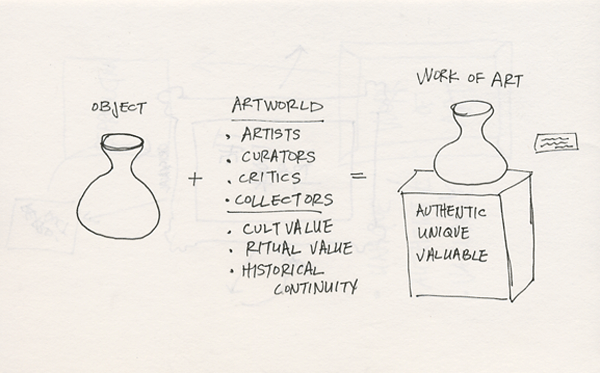
Defining a work of art is actually quite difficult once you begin thinking of the variables involved. The question “what is art?” is often asked and seldom answered. One answer I have heard is that art is something made special. This answer is satisfyingly simple: it gets at an elemental truth, but is ambiguous enough to not rule anything out. The special-ness could be manifest in the something itself or it could be an anything made special by another agent. While one could argue that a work of art has at least an inherent aesthetic quality, many works of art challenge any aesthetic based in culturally defined norms of beauty or even social decorum. In fact, defining art and its value (aesthetic or otherwise) is largely dependent upon context within the art world itself.
Modern and contemporary artists in particular have exploited the contextual nature of what may be defined as art by challenging conventional standards of aesthetics and artistry; Duchamp’s 1917 signed urinal Fountain is an example of an object’s transformation into an art object by means of context. The art history canon has also expanded from within, laying claim to relics of the past or objects of “primitive” cultures—works of art that were in fact created outside of the Western art world. Anything can be art if the right people argue for it in the right place at the right time. In his essay “The Historical Genesis of a Pure Aesthetic,” Pierre Bourdieu described value making in the art world to be a series of struggles among many parties:
The “subject” of the production of the art work—of its value but also of its meaning—is not the producer who actually creates the object in its materiality, but rather the entire set of agents engaged in the field. Among these are the producers of works classified as artistic (great or minor, famous or unknown), critics of all persuasions (who themselves are established within the field), collectors, middlemen, curators, etc. …who confront each other in struggles where the imposition of not only a world view but also a vision of the artworld is at stake, and who, through these struggles, participate in the production of the value of the artist and of art. (1993, p. 261)The result of these struggles creates the value of the art, and the separation of the work of art from everyday life. Through this process art is made special, different from common object commonly seen, even if the art is an everyday ceramic urinal.
Benjamin’s concern with defining what makes art authentic and valuable was a response to the increasing production and use of reproductions; it is this concern of Benjamin’s that makes “The Work of Art in the Age of Mechanical Reproduction” relevant today as the production and access to images increases. Mechanical reproduction, namely photography, posed a threat to previous cultural paradigms centered upon the value of authentic objects. To maintain a cultural agreement on determining value for art in the midst of images multiplying its representation works need to be distinguished as original and authentic. The transformation of ritual use value to authenticity ultimately lead to a means of creating value in which reproduction is an integral part. The reproduced image symbolically distributes the work of art and its defined value across cultural and economic hierarchies, in effect diffusing the power of the original. Therefore, a consequence of reproduction for the work of art is that the work is now designated as an original, a designation that, in John Berger’s opinion, assumes primacy in the cultural negotiation of value:
Having seen this reproduction [of the Virgin of the Rocks], one can go to the National Gallery to look at the original and there discover what the reproduction lacks. Alternatively one can forget about the quality of the reproduction and simply be reminded, when one sees the original, that it is a famous painting of which somewhere one has already seen a reproduction. But in either case the uniqueness of the original now lies in it being the original of a reproduction. It is no longer what its image shows that strikes one as unique; its first meaning is no longer to be found in what it says, but in what it is. (1972, p. 21)
The tension between the original and the reproduction inherently shapes our experience; now we are destined to make comparisons between the two images—original and reproduction—in a new schema based in perceived difference rather than the aesthetic or historical value of the work of art alone.
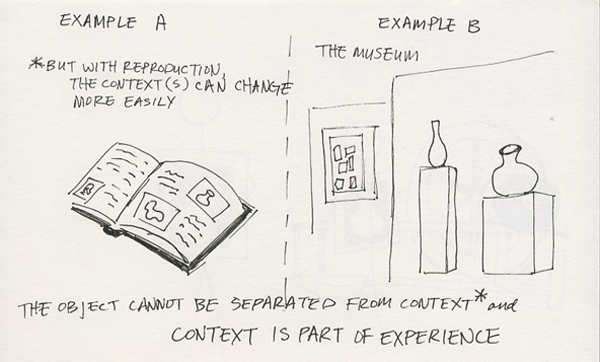
In this section I would like to briefly address a few aspects of reproduced images that seem to be true in any media: the influence of the reproduced image in memory, elements of original works that do not translate well into reproduced images, and the reproduced image as an authoritative object in the absence of the original. Like most of us, there is an abundance of art that I have seen only in reproduced images, and many works of art that I viewed first as reproduced images and only later as originals. My anecdote of visiting the Getty and being surprised by Ensor’s painting is one example of how powerful not only the original work is but how powerful reproduced images are. If I had less faith in the reproduced image I might not have reacted so strongly to the difference between the original and its reproduction. Helene Robert’s informal study of friends and colleagues expressed remarkably strong personal associations with reproduced images, whether viewed as slides in darkened lecture halls, illustrations in art history textbooks, or prints present in the home. In these instances, it seems the experience of the original is secondary to the viewer’s experience of the reproduced image, even when the image misrepresented the original to a large degree. “Often, it was remarked” writes Roberts “the slides shown were pink, faded, blurred, dirty, crooked, cracked, backwards, upside down, mis-identified, or otherwise defective, and the work of art was remembered in this flawed state” (p. 335).
The flawed state of the reproduced image might also be one of less than ideal context. I confess that despite the fact that I have admired Seurat’s Sunday Afternoon on the Island of La Grand Jette hanging in the Art Institute of Chicago in person, my stronger memory of this painting is that of repressed high school student Cameron Frye contemplating all those dots in a scene of the 1980’s movie Ferris Bueller’s Day Off. This memory is one I would hesitate to share in the art history classroom. Museum curators and art historians often work to control interpretations and experiences with their realms of authority; arguably this is part of their professional duty. Peter Walsh, speaking at the Thirtieth International Congress of the History of Art, discussed the futility of art academics’ attempts to separate art from the viewer’s tendency toward subjective interpretations and sentimentality:
[The personal experience is] an essential quality of art as it is truly lived. This is a quality that art museums and art history in general has worked for decades to repress—namely, the messiness of art, its quality of attracting the clutter of personal meanings, bad taste, desiderata, and gross misinterpretation. Moreover, the meaning human beings themselves attach to objects—whether they are great paintings by recognized geniuses, relics of a deified celebrity, or souvenirs of romantic vacations—trumps everything else. In the antique shop, the auction gallery, the museum, or the boudoir, such ‘sentimental’ value outweighs everything else. (2000, paragraph 4)Reproduced images only exacerbate the dilemma of personalized experience and interpretation. My vivid memory of a painting as presented in a film is most likely not what an art historian would prefer because the film re-contextualizes the painting as a visual symbol or narrative device, not a work admired as a unique historical and aesthetic object. But memories are memories nonetheless, and notoriously difficult to shuffle into some hierarchical order of academic quality.